
Get to grips with baccarat before placing a bet
 Available in US
A practical guide to hand rules, live tables, NZ licensing, bonuses and why betting systems cannot overcome the game's odds.

The Baccarat Basics You Need at the Table
Baccarat can look more involved than it is when you first sit down. The table has several betting areas, the game uses multiple decks, and the words Player and Banker sound as though you are choosing a person to play against. For a first look, keep it simpler: baccarat offers three betting options—Player, Banker and Tie—and the cards are dealt from a group of decks.
Those labels name the outcomes you can back, not three different games or three players you need to understand. The basic choice is which of the named options to place a bet on. You can watch a round before joining in and get familiar with where the choices appear on the casino baccarat table. No need to decode every mark at once.
Three names, three betting options
The Player option refers to one of the two hands in the game; Banker refers to the other. Tie is the option for a tied result. The names are easy to misread, particularly if you are used to games where you compete directly with the dealer or other people at the table. Here, they are the labels used for the available bets.
Choosing a baccarat casino in New Zealand means weighing the details that matter to your play and your payments. Use these concise notes as a starting point when considering the options.
-
Lamabet
- Payout speed
- 1-3 business days
Lamabet lists a payout speed of 1–3 business days, a useful detail to consider when you plan withdrawals.
-
Ricky Casino
- License
- Tobique Gaming Commission, licence no. 0000002
Ricky Casino lists a Tobique Gaming Commission licence, number 0000002.
-
7Bit Casino
- License
- Tobique Gaming Commission, licence no. 0000091
7Bit Casino lists a Tobique Gaming Commission licence, number 0000091.
-
BitStarz
- License
- Curaçao Gaming Authority, licence no. OGL/2024/165/0185
BitStarz lists a Curaçao Gaming Authority licence, number OGL/2024/165/0185.
-
Zotabet
- License
- 07017519840
- Payout speed
- 1-3 business days
Zotabet lists licence number 07017519840 and a payout speed of 1–3 business days.
-
Neospin
- License
- Tobique Gaming Commission, licence no. 0000064
Neospin lists a Tobique Gaming Commission licence, number 0000064.
-
Play Grand
- License
- Malta Gaming Authority, licence no. MGA/B2C/370/2017
Play Grand lists a Malta Gaming Authority licence, number MGA/B2C/370/2017.
-
Wintino
- Payout speed
- 1-3 business days
Wintino lists a payout speed of 1–3 business days, which you can factor into your withdrawal planning.
-
N1 Casino
- License
- Malta Gaming Authority, licence no. MGA/B2C/394/2017
N1 Casino lists a Malta Gaming Authority licence, number MGA/B2C/394/2017.
At a physical table, these betting areas are marked on the layout. In an online baccarat game, they appear as buttons or areas on the screen. The presentation can differ, but the three names remain the useful starting point. Take a moment to identify them before you place anything. It is a small pause that saves a common bit of first-time confusion: treating the labels as instructions to pick a role.
Player and Banker are the main choices you will see, with Tie alongside them. That is enough to recognise the betting structure without getting into how a hand is completed or how the options compare mathematically. Those are separate questions. For now, know what the labels refer to and where you would find them.
Why the game uses several decks
A baccarat game is played with between three and eight decks of cards. The exact number depends on the table. Rather than handling one deck by itself, the game combines multiple decks for dealing. In a casino, the cards are kept together in a dealing shoe, the holder from which cards are drawn.
The deck count is part of the game’s setup, not another choice for you to make while betting. You do not need to sort the cards or keep track of which deck a card came from. If you are looking at a casino baccarat game for the first time, the practical point is simply that several decks are in use and are dealt as part of the same game.

You may see different tables set up with different numbers of decks within that range. That variation does not change the three betting labels displayed on the layout. It is also why the table’s information panel can be worth a quick look: it tells you which version and rules are in front of you, rather than leaving you to guess from the felt or screen design.
Getting comfortable with the layout
When you open a casino game called baccarat, start by locating Player, Banker and Tie. Then notice where the game displays the cards and where it shows the current betting areas. You are learning the layout, not trying to read every decorative panel or follow a running history. Some tables show previous results; that display is separate from the basic options available for the current round.
A free baccarat casino game can be a way to inspect the interface without putting money on a bet, if the casino provides that mode. The layout is the thing to learn: where each option sits and how the game distinguishes the three choices. Free play does not make the labels a different set of rules, and it is not a method for discovering a way to win. It is simply practice with the screen.
At a land-based casino, the same familiarisation happens at the table. Look for the marked betting spaces, listen to the dealer’s directions and give yourself a moment to see how the cards are presented. Online, the buttons and prompts do that visual work for you. Either way, you can get your bearings before taking part.
Baccarat does not ask you to choose a card or build a hand in the way some casino games do. Its visible choices are the three betting options, while the cards are dealt from the multi-deck setup. That is the outline worth carrying into your first visit to a baccarat table. The rest can wait until you are ready to learn how a round is settled.
How a Baccarat Hand Works—and Where the House Edge Comes From
Baccarat’s aim is simple: the hand closest to nine wins, without going over. In the casino version called Punto Banco, you bet on the Player hand, the Banker hand or a Tie. Despite those labels, you are not playing against another customer or controlling either hand. The dealer runs the game, and your bet is on which result will occur.
The hand totals follow a short rule: only the last digit counts. A total of 15 therefore counts as five, while a total of nine stays nine. That is why the objective is not to build the highest total in the usual card-game sense, but to finish nearest to nine. Once the result is determined, the winning side is settled according to the table’s payout rules.
The three bets do not offer the same trade-off. The Banker bet has a 1.06% house edge in Punto Banco after the casino’s 5% commission is applied. The commission is part of how the bet is priced: Banker wins are subject to that charge, while the edge figure already accounts for it. The Player bet has a 1.24% house edge. Both are relatively close in mathematical terms, but neither gives the player an advantage over the casino.
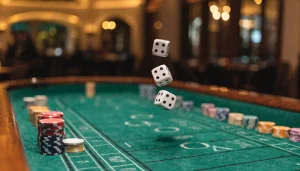
The Tie bet is a different proposition. At an 8-to-1 payout, its house edge is 14.36%, substantially higher than the edge on either main hand. The payout may look appealing because it is larger, but a bigger return on a winning result does not tell you how favourable the bet is overall. The house edge captures the long-run mathematical cost built into the wager.
That is the basic answer to how casinos make money on baccarat: the rules and payouts are arranged so the casino retains a small statistical advantage on the main bets, and a much larger one on Tie at the stated payout. The edge is not a fee taken from every hand. A player can win a particular hand or session; the figure describes the expected result across repeated play, not a prediction of what will happen next.
It also helps to separate the game’s objective from the betting decision. Baccarat does not ask you to make a series of strategic choices about how to build a hand. In Punto Banco, the Player and Banker outcomes are settled under the game’s rules, and your central decision is which result to back. That makes the format easy to follow, but it does not make every available bet equally sound. The Tie bet remains the costly outlier.
A house edge is not a promise that the casino will win each hand, or that an individual player will lose a fixed amount. It is a measure of the casino’s expected share over time, based on the bet’s rules and payout. With the Banker bet, the commission is included in the quoted edge; with Tie, the generous-looking payout still leaves a much steeper mathematical disadvantage. Those details are more useful than judging a wager by its headline return.
Banker
Lowest house edge at 1.06% after the 5% commission is applied.
Player
Relatively low house edge of 1.24%.
Tie
High house edge of 14.36% with an 8-to-1 payout.
So if you are trying to understand the casino edge in baccarat, compare the bets rather than treating them as interchangeable. Banker carries the lowest stated edge of the options covered here, Player is slightly higher, and Tie is far higher at an 8-to-1 payout. None changes the aim of the hand: finish as close to nine as possible. The numbers describe the price of each choice. They do not pick a winner for you.
What to Expect from Live Baccarat
Live baccarat brings a dealer-led table to your screen rather than presenting the game as an entirely digital interface. You watch the round unfold through a video feed, with the table information and betting controls alongside it. That makes the experience feel closer to sitting in a casino, though you are still interacting through the website or app.
The table’s layout is meant to keep the action readable: you can see the current round, the available betting areas and the countdown or other prompt that indicates when betting closes. The dealer manages the table while the software handles the connection between your choice and the round. It is a visual, paced format, not a faster route to understanding the game.
One detail about the format is worth keeping in proportion. A specialist casino review describes live baccarat at NZ-friendly online casinos as almost exclusively using Punto Banco. That is a report about the tables it reviewed, not a permanent rule for every casino or a promise that every live table will look the same. Table names and presentation can vary, so check the information shown in the game before joining.

Speed Baccarat is designed to move through rounds more quickly than a standard live table. A specialist review puts its pace at 60 to 80 hands per hour. Treat that as a reported range for the format, not a guaranteed schedule: the actual rhythm can depend on the table and how its rounds are run. The practical difference is straightforward. There is less pause between hands, so you have less time to look away, reconsider, or keep track of what is happening.
That faster rhythm can suit you if you prefer a brisk session and already feel comfortable with the screen. If you are new to a live table, a less hurried format gives you more room to follow the interface without feeling pushed along. I would start with the pace that lets you pay attention, rather than choosing a table because its name promises speed. Fast is not the same as easier.
The live display may also keep a record of recent results. Read it as a log of what has already happened, not as a forecast or a signal about what comes next. The dealer’s video and the on-screen history add atmosphere and context; they do not change what the next round will bring. Keep your attention on the current table rather than letting a row of previous results pull you into assumptions.
Before settling in, check whether the table is standard or marked as Speed Baccarat, and take a moment to see how its controls are arranged. A quick glance at the pace and interface can make the live format feel much less distracting. If the round moves too quickly for you to follow comfortably, switch to a slower table or leave it there. No drama.
Check the NZ Licensing Picture Before You Play
A casino’s “licensed” label needs context in New Zealand. For years, online casino sites serving New Zealanders from overseas were not licensed or supervised by a New Zealand regulator. The Online Casino Gambling Act 2026 has now created the country’s first domestic licensing framework, but that does not mean the new system is already issuing licences.
The roles are split. The Department of Internal Affairs is New Zealand’s primary gambling regulator and oversees the online casino framework. The Gambling Commission handles licensing decisions: it hears and determines applications, issues online casino licences, and approves changes to licence conditions. In plain terms, the Department oversees the framework; the Commission decides who gets a licence and what changes can be made to its conditions.
That distinction matters when comparing baccarat casinos. A site may have operated in New Zealand for years, or display a licence from another country, without holding a New Zealand online casino licence. Those are not the same thing. A foreign licence does not become a domestic one simply because the site accepts New Zealand customers, and the new legislation does not turn every existing operator into a licensed provider.
For now, no operator is licensed under the new New Zealand regime. So don’t read “check the licence” as a suggestion that you can already choose from a pool of locally licensed baccarat casinos. Instead, check what the operator says about its status and whether it is operating under, or preparing for, the new framework. Then look for information that identifies the relevant regulator and the actual licence status, rather than relying on a vague badge or a general claim of being regulated.

The point is practical, not ceremonial. Before the new framework, a customer using an offshore site had no domestic government recourse if something went wrong. A New Zealand licence is intended to bring operators within local oversight, but until licences are issued, that protection should not be assumed. If a baccarat casino’s wording blurs the difference between an overseas licence and a New Zealand one, treat that as a reason to pause and verify.
This is especially worth doing when a page calls itself a guide to the best baccarat casinos in New Zealand. A ranking or polished review cannot establish an operator’s regulatory status. Check the operator’s own information against the roles of the Department of Internal Affairs and the Gambling Commission, and be clear about what the site can and cannot claim today. No badge-reading by instinct.
Playing Your First Hand: A Simple Walk-Through
If you’re wondering how to play baccarat at a casino, start with the choice in front of you: Player, Banker or Tie. Those are the three places you can bet. You’re backing the outcome you think will happen, not choosing cards or steering the hand yourself.
Before you take part, look at the table layout and find those labels. Give yourself a moment to get comfortable with what each betting area means. I’d keep the first hand simple: choose one option, place your bet in its marked area and wait for the hand to finish. There’s no need to split your attention between several choices while you’re still getting used to the table.
The aim of baccarat is for a hand’s total to come as close to nine as possible without going over. Keep that in mind as you follow the action. You don’t have to make decisions about which cards to take; your part is to pick a betting option and see whether the result matches it. That makes baccarat easier to follow than games where you have to make a series of choices during a hand.
A first visit can feel less straightforward than the rules sound. The table may be busy, and it can be tempting to copy the person beside you without knowing what their bet means. I wouldn’t. Take a breath, read the labels, and ask the dealer if you’re unsure where to place your bet. A quick clarification is better than guessing.

Once the hand is over, check the result against the option you backed. If it didn’t match, that’s simply the outcome of that hand; it doesn’t tell you what the next one will do. If you want another go, pause and choose again rather than placing a bet on autopilot. The point of this first round is to understand how you take part, not to find a pattern or a guaranteed way to win. There isn’t a choice that lets you control the cards.
The Tie option can look especially inviting because it is clearly marked alongside the other two. Treat it as a separate outcome you’re choosing to back, not as a way to cover both Player and Banker. For now, focus on the basic rhythm: make one clear choice, follow the hand, then decide whether you want to continue.
That’s enough to get started. You don’t need to memorise a system before sitting down; just know what you’re backing and stay attentive to the table. Your first hand is a chance to learn the routine, not a test you have to pass.
Baccarat Rules, Commission-Free Tables and the ‘Tricks’ to Ignore
“Commission-free” sounds like a simpler deal: the casino does not deduct commission from a winning Banker bet. But check the table rules before you sit down. Some commission-free games balance that missing charge by changing what happens when the Banker wins with a total of 6.
At such a table, that specific Banker win pays half the stake rather than an even-money return. So a winning bet does not always bring back the same amount. The altered payout is the trade-off for avoiding commission; it is a rule variation, not a special advantage hidden in the table.
That detail is easy to overlook when you see “no commission” in a game title. Read the payout information on the table itself and look for the condition attached to a Banker 6. If the rules are unclear, do not assume that commission-free means every Banker win pays in the same way. A small line in the rules can matter more than the label.
The effect is measurable: the Banker bet in commission-free baccarat has a house edge of 1.46%. That figure belongs to this version of the game, with its reduced payout for a Banker 6. It is not a promise about what will happen in a session, and it does not mean the house edge is a fee taken from each individual bet. It describes the long-run mathematical disadvantage built into the wager.
For comparison, standard Punto Banco applies a commission to winning Banker bets instead of reducing that particular payout. The two approaches handle the cost differently. Neither removes the casino’s edge; they simply express the table terms in different ways. Check which version you are playing rather than relying on the game name.
As for casino baccarat tricks, be wary of claims that a reading method or a clever sequence can make the Banker-6 rule work in your favour. You can choose a table with terms you understand, but you cannot turn a reduced payout into an even-money one by timing your bet or following a pattern. The rule applies when that hand occurs, regardless of what you staked previously.
I treat “commission-free” as a prompt to inspect the payout rules, not as a signal that the table is better value. The practical move is plain: understand the Banker-6 condition, decide whether you accept it, and keep your bet within the terms shown. No secret route around the maths.
Baccarat Sites, Bitcoin and New Zealand’s Licensing Transition
Searching for a baccarat table can bring up sites that accept New Zealand players, including some that take Bitcoin. But a payment option tells you nothing about whether a casino is covered by New Zealand’s new licensing framework. The same check matters whether you plan to deposit with cryptocurrency or another method.

The Online Casino Gambling Act 2026 created the country’s first domestic licensing regime for online casino gambling. It came into force on 1 May 2026, but that did not mean licensed casinos were immediately available. The law set a transition period through 1 December 2026. During that window, online casinos already serving New Zealand customers before 1 May may continue operating under the Act’s transitional provisions.
That distinction matters when comparing sites. A casino accepting Bitcoin is not necessarily licensed locally, and a casino offering baccarat is not automatically part of the future regulated market. Before treating a site as covered by the new rules, check whether it is operating under, or preparing for, the Online Casino Gambling Act 2026 framework. Don’t mistake a familiar game menu or a cryptocurrency cashier for proof of local approval.
There is also a timing wrinkle. A specialist market review reports that no operator is currently licensed and expects the licensed market to begin around 1 December 2026. The wider regime is not expected to be fully operational until 2027. Those milestones are not the same thing: the transition may end before the full system is running. Check current status rather than relying on an old page or a confident banner.
Once licensed, operators must provide tools that let you set deposit limits, use session timers, receive reality checks and exclude yourself from play. These are practical safeguards to look for as the market moves into its regulated phase. They do not, by themselves, establish that a particular site already holds a licence.
Bitcoin can add another layer of distance between you and a casino, but it does not change the licensing question. If a site is outside the New Zealand framework, the currency used to fund play does not bring it inside that framework. Before depositing, check the operator’s status and read the terms for how cryptocurrency payments and withdrawals are handled. Clear answers matter more than a long list of payment logos.
The transition is still the key context for anyone weighing online baccarat options in New Zealand. A site may be accessible without being locally licensed, so separate access from regulatory status. That small distinction is easy to miss.
Online Baccarat Bonuses: Read the Wagering Terms First
A bonus can look straightforward until you check what the wagering requirement applies to. In a specialist review of the operators covered on this page, the condition applies to the deposit as well as the bonus. So the amount you must wager is not calculated on the bonus alone. Read that line carefully before accepting an offer; the difference affects how much play is required before bonus-related funds can be withdrawn.
The wording matters. “Deposit plus bonus” means both parts count towards the requirement. It does not mean you can simply wager the bonus amount and treat your own deposit as separate. If you are comparing a baccarat offer at one casino with another, check the calculation basis first rather than judging by the headline bonus.

The terms should also spell out the other conditions in plain language. Bonus funds carry a wagering requirement of at least 50 times within 30 days. Withdrawal requests void all active or pending bonuses, and Skrill and Neteller deposits are excluded from bonus offers. Breaking the stated maximum bet, even once, is grounds for the operator to void the bonus and any winnings attached to it. These are not small-print niceties; they can determine whether an offer is usable for the way you intend to play.
For baccarat in a casino, make sure the bonus rules say whether the game contributes to wagering and on what basis. Do not assume every game counts equally, or that a bonus can be used on every table. If the terms do not make that clear, ask the operator before opting in. Keep a copy of the terms you accepted, too. It is easier to check a disagreement against the original wording than to rely on memory after several sessions.
The same checks apply if you are weighing up a best baccarat online casino in New Zealand or considering a Bitcoin baccarat casino. A payment method does not change the wagering calculation, but it may affect bonus eligibility: Skrill and Neteller deposits are excluded. Read the full terms attached to the offer, including eligibility and withdrawal conditions, before depositing. A large headline offer is not automatically the better one. The maths starts in the terms.
Punto Banco: The Casino Baccarat Format to Know
Punto Banco is a casino version of baccarat in which you bet against the dealer. The name describes the format, not a separate game of skill or a head-to-head contest with another customer. If a casino labels a table Punto Banco, that tells you the basic relationship: you place a wager on the game’s available outcomes, while the dealer represents the house.
- Punto Banco
-
A specific casino format of baccarat where the player bets on the outcome of hands dealt and settled by the dealer representing the house.
That distinction matters because “baccarat” can refer to the broader family of games, while Punto Banco is a particular casino format. It gives you a useful label to look for when comparing tables, without implying that every baccarat game is presented in exactly the same way. I find it clearer to start with the format name, then check the table information rather than assume the label answers every question.
Punto Banco is also not another name for live-dealer baccarat. One describes the game format; the other describes how the game is presented. A live table can offer Punto Banco, but the words are not interchangeable. The same distinction helps when browsing online: a live-dealer heading tells you something about the presentation, while Punto Banco identifies the kind of baccarat being played.
For a newcomer, the practical takeaway is simple. You do not need to learn a different format just because the table is called Punto Banco. Treat it as the casino version of baccarat, and read the rules shown for the specific table before you join. Table labels can tell you what you are looking at; they do not replace the rules displayed by the operator.
This format is common in casino baccarat because it gives the player a direct set of betting choices while keeping the dealer on the house side of the game. It is not a promise that the casino offers a particular pace, interface, or style of presentation. Those details belong to the table itself, not to the name Punto Banco.
So when you see Punto Banco among casino games, read it as a format label: baccarat played with bets against the dealer. Keep that separate from the live-dealer experience and from broader descriptions of baccarat. A small distinction, but a useful one.
Baccarat Betting Systems Won’t Beat the Odds
If you’re looking for casino baccarat winning tips, betting systems can sound reassuring: follow a pattern, raise or lower your stake at the right moment, and the results should turn. The catch is that a progression changes your stake, not the odds of the game. It cannot make a hand more likely to go your way.

Martingale is the familiar example. You increase your bet after a loss, hoping that a later win will cover the losses and leave a profit. But the plan depends on being able to keep raising your stake until that win arrives. A losing run can make the required bets grow quickly, and the system offers no guarantee that a win will arrive in time. That is a lot of confidence placed in a sequence you don’t control.
There is another snag when you use the Banker bet. Its 5% commission means a winning bet does not return the same amount as an equivalent winning Player bet. So even if a Banker win follows losses, the payout can fall short of what a Martingale progression needs to recover them. A win is not automatically a recovery. The commission gets in the way.
I’ve found it helpful to treat any system as a way of organising stakes, not as a method for changing the game’s chances. That distinction is easy to lose when a betting pattern has worked for a few hands. Short-term success can make a system feel proven; it hasn’t changed what happens on the next deal.
The same goes for reading a run of results. A string of Banker wins, or a stretch without a Tie, does not forecast the next hand. Recent outcomes are history, not a signal that the next result is due to correct itself. Baccarat has no memory.
So, how to win in baccarat in a casino? There is no betting sequence that guarantees it. If you choose to play, decide what you are comfortable staking and stop when you reach your limit; don’t raise bets because a system says losses are about to be recovered. A neat pattern is not an edge.
What is the Online Casino Gambling Act 2026, and how does it affect live baccarat?
It establishes a domestic licensing framework for online casinos operating in New Zealand. Licensed operators must offer deposit limits, session timers, reality checks and self-exclusion; the market is expected to launch around 1 December 2026, and no operator is currently licensed.
What are the rules of Punto Banco, and how does the game work?
You bet on the Player hand, the Banker hand or a Tie; the dealer runs the game, and you do not control either hand. The aim is for a hand to finish closest to nine, with only the last digit of its total counting.
What is the house edge on Banker, Player and Tie bets?
In Punto Banco, the house edge is 1.06% on Banker after the 5% commission, 1.24% on Player and 14.36% on Tie at an 8-to-1 payout.
What does “wagering on deposit plus bonus” mean?
It means the wagering requirement applies to the combined amount of your deposit and the bonus, rather than to the bonus alone.
Casinos in New Zealand: Games, Apps and Guides
Content created by the «casinotips-nz.com» team