
Make Sense of Craps Before Choosing Where to Play
 Available in US
A practical guide to the shooter, Pass Line rounds, beginner bets, online play, odds and bonus terms for New Zealand players.
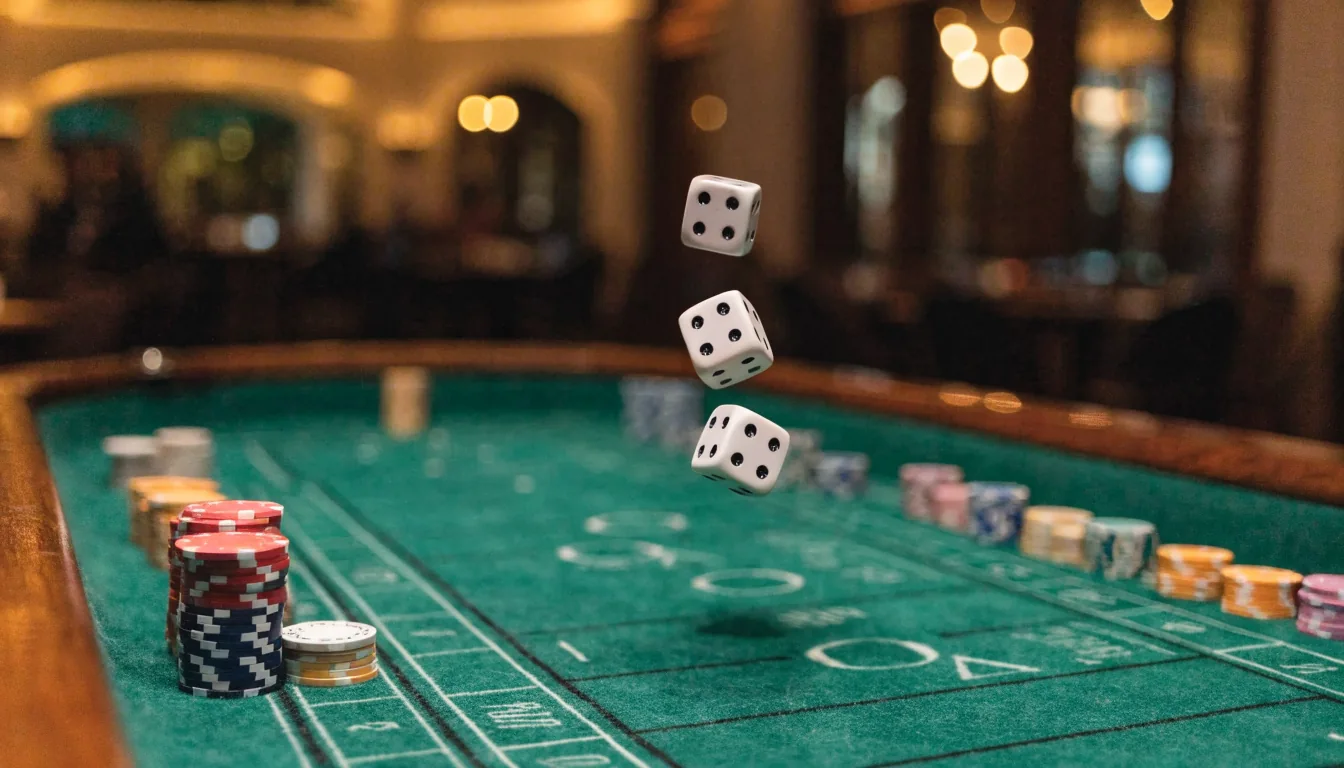
The Craps Table: Dice, Shooter and the Flow of a Round
A craps table can look busy before you know what to watch. Players stand along its edges, the betting layout runs across the felt, and the dice move between the shooter and the person managing the game. But the action has a simple centre: a pair of dice, a designated shooter and the roll that tells everyone what happens next.
The shooter is the player whose turn it is to roll. That role moves around the table as play continues; it is not a special position that gives someone control over the dice. The shooter handles the pair and sends them across the table. Other players may have bets in play, but they are watching the same roll. That shared focus is a big part of why craps feels different from many casino table games.
The dice themselves are ordinary-looking, but the way they are handled matters to the rhythm of the game. The shooter rolls both together, and the table waits for them to settle. Until then, there is no result to read. When they stop, the dealer calls the outcome and the layout gives the table a clear reference for what has happened. You do not need to track a private sequence or interpret a complicated signal: the roll is public.
I find the easiest way to read the table is to start with the come-out roll. It is the opening roll for a Pass Line bet, and its result sets the immediate direction of play. A 7 or 11 wins that bet; a 2, 3 or 12 loses it. Any other result establishes a point. Those outcomes are the basic landmarks. They explain why the first roll gets so much attention, without requiring you to memorise the whole layout.

The point is a number the table now has to keep in view. A marker on the felt identifies it, so players and dealers can see the current state without having to reconstruct what happened earlier. The marker is a useful bit of table language: it turns a roll into a reference for the action that follows. For now, the important thing is simply that the come-out roll can either settle the Pass Line bet immediately or establish that reference.
Around the shooter, the crew keeps the game moving. The dealer handles bets and payouts, while the stickperson manages the dice and calls the results. Their work can seem quick when you are new, but it is organised. The calls, gestures and movement of chips are not decoration; they help everyone follow which bets are active and what the latest roll means. If you are unsure, watching the crew is often more useful than trying to scan every marking on the felt at once.
A craps casino table also has a distinct shape and layout, designed so players around its sides can take part in the same game. The betting areas are printed directly on the felt. At first glance, all those boxes can make the game seem more complicated than it is. You do not have to understand every area to follow the dice. Keep your attention on the shooter, listen for the result, and notice whether the table is still on the come-out roll or has a point marked.
That last distinction helps you make sense of the room’s reactions. A roll can matter differently depending on where the table is in the round, so a number does not carry the same meaning in every moment. The opening result is the cleanest reference: the Pass Line outcomes above show how a come-out roll can resolve a bet or set a point. Once you understand that, the dealer’s calls stop sounding like a stream of unfamiliar terms.

Craps is social, but the decisions remain individual. A crowded rail does not change what the dice show, and the shooter’s confidence or routine cannot make a particular result more likely. The table may cheer a roll or groan at it; that is atmosphere, not information about the next one. I would treat the dice as the centre of the game and the crowd as background.
There is no need to approach the table as if you must learn every marking before you can follow what is happening. Start with the roll, the call and the point marker. The shooter supplies the action; the crew makes its meaning visible. Once those pieces click, even a busy craps table feels less like noise and more like a game with a rhythm. Dice first. Everything else follows.
How a Pass Line Round Unfolds
A Pass Line round has two distinct parts. First comes the come-out roll, which decides whether the bet is settled immediately or whether the table moves into a longer contest. If that opening roll is 7 or 11, the Pass Line wins. A 2, 3 or 12 means it loses. Any other result establishes a point, and the round continues.
That change is easy to miss when you are watching the dice rather than the table. Once a point is on, the aim is no longer simply to see what the next roll brings. The shooter is trying to bring back the established number before a 7 appears. The same two outcomes now have different significance from their role on the come-out roll: the point keeps the Pass Line round alive and wins it if repeated, while a 7 ends it as a loss.
The point changes the pace
Before a point is established, a single roll can settle the Pass Line bet. Afterwards, the round may take several rolls, with each result leaving the main contest unresolved unless it is the point or a 7. That is why you will hear the table respond differently to the same number depending on where the round stands. The roll has not changed; the state of play has.

You can follow the sequence without trying to track every bet on the layout. Notice the come-out, then listen for the point being marked. From there, keep one question in mind: has the shooter repeated the point, or has a 7 appeared first? The rest of the table can look busy, but those are the outcomes that decide the Pass Line round once the point is set.
That simple timeline also helps explain why a roll that looks like a fresh start to a newcomer may not be one. While the point is active, an unrelated result does not reset the round. The shooter continues, and the table remains in the same phase. The decisive event has yet to happen.
The point is repeated
If the shooter rolls the point again before a 7, the Pass Line bet wins and that round is over. The table then returns to a come-out roll for the next round. It is a clear ending, even if the rolls in between made the wait feel longer than the result itself.
At the table, this is often the moment when attention gathers around the dice. People may follow the shooter’s progress, but the sequence is not a prediction puzzle: a run of other results does not tell you that the point is due. You are simply watching to see which of the two relevant outcomes arrives first. No pattern in the previous rolls changes the round’s basic condition.
A 7 appears first
If a 7 comes before the point is repeated, the Pass Line bet loses and the round ends. That is the other possible close to the point phase. The distinction between the two endings is worth keeping clear: the point arriving first wins the Pass Line, while the 7 arriving first defeats it.
Pass Line Sequence
-
1
The Come-out Roll
The shooter rolls the dice. A 7 or 11 wins immediately, a 2, 3, or 12 loses, and any other number establishes a point.
-
2
Establishing the Point
If the first roll is not a 7, 11, 2, 3, or 12, that number becomes the point, and a marker is placed on the felt.
-
3
The Race
The shooter continues to roll. The round ends when either the point is repeated (a win) or a 7 appears first (a loss).
For a first-time viewer, the quick version is: come-out roll, point established, then a race between the point and a 7. It is tempting to treat every roll as a separate decision, but the round has a continuing state. The point remains the target until one of those two outcomes settles the bet.
Following the table without losing the thread
When the dice move quickly, focus on the table’s current phase rather than trying to read every chip placement or follow side action. At the start of a round, the come-out roll determines whether the Pass Line is decided straight away or carried into the point phase. Once the point is set, remember that the shooter needs to repeat it before a 7 to win that bet. If neither appears, the round is still in progress.
This is also a useful way to watch a live table or an online display. Look for the marker or other indication that a point has been established, then keep track of whether the point or 7 ends the round. The presentation may differ between tables, but the central timeline does not.
There is no need to turn that timeline into a system for calling the next roll. A point phase can last through several results, or end on the next one; the sequence gives you the rules of the round, not a way to know its length in advance. Keep the two phases straight and the action becomes much easier to follow. The dice still decide.

What Makes Craps a Casino Game of Its Own
Craps is a casino dice game where the action centres on the shooter’s rolls and the bets players make around them. You are not playing a hand against a dealer or trying to build a private combination of cards. Instead, the table follows the dice, and several players can have different wagers riding on the same roll.
That shared action gives craps its particular feel. A roll can settle some bets while leaving others in play, so the table’s attention tends to move together even when players have chosen different positions. You can watch the same sequence as everyone else, but your result depends on the bet you made. There is plenty going on, yet the central reference point is simple: the Pass Line.
For someone learning what craps means in a casino, the Pass Line is a useful anchor because it gives the round a clear, familiar direction. It is tied to the shooter’s attempt to make the main outcome work, rather than to a side condition or a prediction about a particular roll. You do not need to understand every marked area on the layout to grasp the basic purpose of the game. Start by following the main wager and the dice; the rest of the table can wait.
That does not mean craps is just a Pass Line game. The layout offers other bets, and players may take different views of the same action. But the Pass Line provides a straightforward reference for understanding what the table is doing. It also gives you a practical way to compare casino craps games: check whether the rules and paytable are clearly displayed, and whether the game presents the central wager in a way you can follow. A busy layout is no substitute for clear rules.
The Pass Line has a house edge of approximately 1.41%. That figure describes the bet’s mathematical cost over repeated play, not what will happen on your next roll. It is useful context when you are deciding whether this basic wager suits you, but it is not a prediction or a promise of a particular result. The point of a reference bet is to make the game easier to understand, not to make the dice behave.
Craps can look more complicated than it is because many wagers sit beside the main action. My own first instinct was to treat every marked space as something I ought to learn at once. That is a quick way to lose track of what the roll means. Keep the Pass Line in view and the game’s structure becomes easier to read, without turning the table into a test of memorisation.
When you compare a craps casino with other games, the main difference is this shared, roll-by-roll rhythm. The dice supply the event; the table’s wagers give that event different meanings for different players. You can follow the central bet first and explore the wider layout only when you feel ready. No need to learn the whole table at once.
Craps Tips That Keep a Session in Hand
A useful craps session starts before the dice move. Decide what you can afford to lose, set a stop-loss, and choose a session limit while you are still thinking clearly. Treat those limits as fixed, not as figures to renegotiate after a run of bad rolls. A table can be lively; your spending plan should not be.

You may see a specialist review suggest a session bankroll of 20–50 times your base bet. That is one source’s recommendation, not a standard that suits every Kiwi punter. Your own budget matters more than a borrowed multiplier. Set a deposit limit that fits your finances, and do not move money into the account simply because the session has turned against you.
A cold streak is a good point to step away, not a signal to push harder. Take a break, get out of the rhythm of the table, and check whether you still want to play. If you feel the urge to chase losses, end the session. Increasing bets to catch up can make a poor stretch more expensive; it cannot make the dice behave differently. Keep it simple.
It also helps to decide what a win means to you before you start. You might choose to stop when you have reached a personal target, or simply leave when you no longer feel in control. The particular stopping point is yours; the important part is making the decision away from the heat of the game. A session limit is not a challenge to use every minute or every dollar available.
Do not treat a staking plan as a way to forecast outcomes. Craps tips can help you avoid impulsive decisions, but no pattern of earlier rolls gives you a reliable read on the next one. I would rather see a player use a plain, affordable plan than try to recover a loss with a sudden change in stake. No system can remove the game’s uncertainty.
For online play, make use of deposit and session limits where they are available, and consider self-exclusion tools if taking a break is not enough. Before depositing, check the casino’s identity-verification steps, its anti-money-laundering practices, and its payout history. These checks do not predict a result at the table, but they matter when you are deciding whether the site is suitable for you.
Do
- Set a fixed stop-loss and session limit before playing
- Use deposit limits that fit your finances
- Take a break after a cold streak
- Keep records of your winnings
Don't
- Renegotiate limits after a run of bad rolls
- Deposit more money to chase losses
- Raise stakes to recover a loss
- Treat staking plans as a way to forecast outcomes
Keep an eye on what happens after a large win, too. An operator may carry out checks, and the Inland Revenue Department may take an interest. That is not a reason to assume a win will be trouble; it is a reason to keep records and understand that a withdrawal may involve review.
My rule is plain: choose your limits before you play, pause after a cold streak, and leave when the plan says leave. The dice can wait.
Craps Rules, Pass Line Strategy and the Cost of a Bet
The house edge is a useful way to compare the basic craps bets. It describes the casino’s mathematical advantage over repeated play, not a prediction of what will happen in your next turn. A short session can go either way; the percentage is about the long-run cost built into the bet.
A Pass Line bet carries a house edge of approximately 1.41%. Don’t Pass is slightly lower, at about 1.36%. The gap is small, but it shows that the two main starting choices do not have identical costs. If you prefer a simple approach, that comparison is more useful than looking for a system that claims to overcome the table’s mathematics.

The rules determine how those bets relate to the roll, but the important point here is the price of the choice. Pass Line is the familiar reference for many players. Don’t Pass takes the other side of the central outcome, and its lower edge does not make it a guaranteed better result for an individual player. You may have a preference about the feel of one option; the house edge tells you what the underlying trade-off is.
Odds bets are different. When placed behind a Pass Line bet, they carry no house edge of their own. That does not erase the cost of the Pass Line bet they depend on. Think of the two parts separately: the base bet has a house advantage built into it, while the odds portion does not. “No house edge” is a description of that portion, not a promise that the overall wager will win.
For a straightforward choice, I would compare the base-bet edge first and avoid treating extra complexity as an advantage in itself. Craps rules and strategy often get tangled together, but knowing the relative cost gives you a cleaner way to decide whether a bet suits you. It will not change the dice or make a result predictable.
Keep the distinction in mind if you see a low edge presented as proof that a bet is risk-free. It is not. Your stake remains exposed to the game’s outcomes, and a mathematical edge describes the casino’s long-run position, not the result of one roll. Large wins may also trigger operator checks and attract IRD interest. The percentages are a comparison, not a forecast.
Your First Craps Bets: A Beginner’s Starting Point
If you are learning how to bet craps at a casino, keep your first decision simple: place a Pass Line bet before the come-out roll. You do not need to call every roll or learn the whole betting layout at once. Start by knowing what that one bet means and what the first roll can do to it.
The Pass Line is the main starting point for a new player. Put your chips in the marked Pass Line area before the shooter makes the come-out roll. If you are unsure where they belong, ask the dealer before the roll begins; table staff can clarify placement. Once the dice are in motion, it is too late to add a bet for that roll.
There are three possible outcomes for your Pass Line bet on the come-out roll:
- A 7 or 11 means the bet wins.
- A 2, 3 or 12 means the bet loses.
- Any other number establishes the point.
That last result is not an immediate win or loss. It gives the round a target, and the Pass Line bet remains in play. You can learn that next stage after you are comfortable recognising the first-roll outcomes. For now, focus on reading the result without feeling obliged to place another bet.
You may hear “shoot craps” used to mean taking a turn as the shooter, the person rolling the dice. Being the shooter does not require a different Pass Line bet: the bet is about the result, not who throws. If you would rather watch first, do that. A few minutes observing where bets go and when the dealer accepts them can make your first turn less rushed.
I would avoid adding several unfamiliar wagers just because the table looks busy. One Pass Line bet gives you a clear reference point; extra bets add decisions, not control over the dice. Stick to a pre-set staking plan, set a stop-loss and session limits before you begin, and take a break after a cold streak. Do not raise your bet to catch up.
If you play online, the same basic come-out outcomes apply, though the controls and presentation differ. Large wins may prompt operator checks and attract IRD interest, so keep records and respond to any verification request. A calm first bet is enough. No need to make a production of it.

Live and Online Craps: What the Dice Experience Looks Like
At a physical craps table, the dice are in front of you, the shooter is part of the room, and the pace depends on the people around the layout. You can hear the calls, watch the table react and follow the action without needing to interpret a screen. That atmosphere is the main thing online play cannot reproduce exactly.
Online craps comes in a few broad forms. A digital table presents the game on screen, with the dice outcomes generated electronically. It is a more self-contained experience: you follow the display and make your choices through the interface, without a live table or other players’ reactions shaping the mood. The presentation varies between games, so one version may feel spare while another adds more visual detail. More animation does not change the underlying dice game.
Live casino craps uses a real table and a streamed dealer or table crew. You see physical dice being handled and rolled, while controls on your screen let you take part remotely. It brings some of the visual rhythm of a casino floor into an online session, though the stream and interface still sit between you and the table. It can feel more social than a digital game, but it is not the same as standing beside the layout.
Digital Craps
An electronic experience where outcomes are generated by software via a digital interface.
Live Casino Craps
A streamed experience featuring a real table and crew, combining physical dice with remote controls.
Physical Craps
An in-person experience at a casino floor with a live atmosphere and direct interaction with the shooter.
Neither format makes the dice more predictable. A polished stream, a busy table or an animated roll can make the experience feel different; none gives you a reliable read on what will come next. I find it useful to separate the atmosphere from the game itself. The screen can add theatre. The roll remains uncertain.
For a Kiwi punter, offshore online craps sites remain accessible from New Zealand. That tells you the games can be reached; it does not tell you whether a particular version suits the way you want to play, or settle questions about local rules. Those are separate considerations, not something a live stream or a familiar-looking table answers for you.
If you are comparing formats, start with the experience you actually want: a real table on camera, a digital interface, or the energy of a casino floor in person. Then notice how clearly the game presents its controls and results before committing to a session. There is no need to treat a live feed as proof of better outcomes, or a digital table as a shortcut to them. Different feel, same uncertainty.
Craps Odds and Bonus Terms to Check Before You Play
An odds bet can look like the cleanest part of a craps wager: when it sits behind a Pass Line bet, the odds portion has no house edge. That does not make the whole wager cost-free. The Pass Line bet still carries a house edge of approximately 1.41%, so the odds bet does not erase the built-in cost of the bet it supports.
Keep those parts separate when comparing craps casino odds. The Pass Line is the underlying wager; odds are an additional bet linked to it. “No house edge” describes the odds bet’s mathematical cost, not a promise that you will win or a way to make the original bet fair. Your result can still go either way, and a bonus may treat the two parts differently.
Before accepting a casino craps bonus, read the wagering terms for game eligibility. Craps may be excluded from qualifying play altogether. Alternatively, the promotion may count craps wagers only under specific conditions or cap the permitted bet at NZ$5 while wagering requirements apply. That cap can matter even if the table itself accepts a larger wager: breaking a promotion’s terms could affect whether the bonus or related winnings qualify.
Check how the rules define a qualifying bet, whether odds wagers count, and whether the restriction applies to each bet or the whole round. Look for any separate rules on bonus funds, cash funds and withdrawals. If the wording does not make clear how a Pass Line wager and its attached odds are treated, ask the operator before playing rather than assuming both count the same way. Promotions are paperwork with dice attached.
- Read the wagering terms for craps game eligibility
- Check for maximum bet caps (e.g., NZ$5) while wagering
- Verify if odds wagers count toward requirements
- Review identity and payment verification rules
A useful comparison is to calculate your intended play without the bonus first. Then decide whether the promotion’s restrictions change how you would otherwise wager. A bonus is not automatically worthwhile just because the displayed amount looks generous; restrictions can make a straightforward craps session harder to manage. Do not raise your stakes to meet a wagering condition or keep playing simply to clear one.
Also read the operator’s rules for identity and payment checks. Large wins may lead to additional operator checks and may attract IRD interest. Recreational gambling winnings are generally tax-free in New Zealand, but that does not remove the possibility of questions about a substantial win. Keep records and respond to reasonable verification requests.
The short version: the odds portion has no house edge, but the Pass Line bet still has a cost, and bonus rules can narrow how you use either. Read the conditions before depositing, not after the dice have started moving.
Playing Online Craps from New Zealand in 2026
Choosing a craps casino in New Zealand calls for checking the details that matter to you before you play. Use this list as a starting point and verify the current game and account information directly with each operator.
-
Lamabet
- Payout speed
- 1-3 business days
Lamabet lists a payout speed of 1–3 business days, a detail you can weigh when considering how quickly you want withdrawals processed.
-
Ricky Casino
- License
- Tobique Gaming Commission, licence no. 0000002
Ricky Casino lists a Tobique Gaming Commission licence, number 0000002, giving you a specific licensing detail to check.
-
7Bit Casino
- License
- Tobique Gaming Commission, licence no. 0000091
7Bit Casino lists a Tobique Gaming Commission licence, number 0000091, which you can use as a reference when reviewing its licensing information.
-
BitStarz
- License
- Curaçao Gaming Authority, licence no. OGL/2024/165/0185
BitStarz lists a Curaçao Gaming Authority licence, number OGL/2024/165/0185, a concrete licensing detail for you to review.
-
Zotabet
- License
- 07017519840
- Payout speed
- 1-3 business days
Zotabet lists licence number 07017519840 and a payout speed of 1–3 business days. You can review both details when assessing the operator.
-
Neospin
- License
- Tobique Gaming Commission, licence no. 0000064
Neospin lists a Tobique Gaming Commission licence, number 0000064, providing a specific licensing reference for you to check.
-
Play Grand
- License
- Malta Gaming Authority, licence no. MGA/B2C/370/2017
Play Grand lists a Malta Gaming Authority licence, number MGA/B2C/370/2017, which you can use to identify its stated licence.
-
Wintino
- Payout speed
- 1-3 business days
Wintino lists a payout speed of 1–3 business days, a practical detail to consider if withdrawal timing matters to you.
-
N1 Casino
- License
- Malta Gaming Authority, licence no. MGA/B2C/394/2017
N1 Casino lists a Malta Gaming Authority licence, number MGA/B2C/394/2017, giving you a specific licensing detail to verify.
For a Kiwi punter, the key distinction is between where you play and where the operator is based. New Zealand residents may gamble on offshore websites, and offshore craps sites remain accessible. That does not mean an online casino can set up its operation physically in New Zealand: the Gambling Act 2003 bars remote interactive gambling operators from being based here.
The legal picture changed in 2026. The Online Casino Gambling Act 2026 took effect on 1 May, creating New Zealand’s first domestic licensing framework for online casino gambling. It also set a transition period through 1 December 2026. Providers that were already serving New Zealand customers before the Act began may continue during that period, subject to the transition rules. The full licensed regime is not expected to be operating until 2027.
So, when you look for online craps, don’t confuse an offshore site being reachable with it holding a New Zealand licence. Before the new framework, gambling supplied from offshore was not licensed or supervised by a New Zealand regulator, leaving customers without domestic government recourse. The transition changes the regulatory landscape, but it does not turn every accessible offshore site into a locally licensed operator. A useful distinction. Not a small one.

The Department of Internal Affairs oversees regulation of the online casino licensing framework. The Gambling Commission handles licensing applications, issues online casino licences and approves changes to licence conditions. These roles belong to the emerging domestic system; they should not be read as confirmation that a particular offshore site has been licensed.
Recreational gambling winnings are generally tax-free in New Zealand, but large wins may prompt operator checks and attract IRD interest. Keep records and respond to any verification requests. The legal position of the operator and your own tax circumstances are separate matters.
If you choose to play, make sure you understand whether the operator is offshore and what that means for your protections.
What to Check Before Choosing an Online Craps Casino
A polished site tells you little about how it handles a withdrawal. Before choosing where to play craps, read the cashier terms and check which payment methods are actually available to you, whether your balance and payouts are handled in NZD, and whether the site explains withdrawal steps clearly. A specialist review identifies POLi, bank transfers and Apple Pay as options that may be offered to Kiwi punters; availability depends on the operator.
Check the payout history as well as the payment menu. Look for a clear process for pending withdrawals, identity checks and requests for additional documents. KYC (know-your-customer) checks and anti-money-laundering procedures are part of player protection, even if they can mean answering questions before money is released. Large wins may also prompt operator checks and attract IRD interest. Recreational gambling winnings are generally tax-free in New Zealand, but that does not remove the possibility of checks.
The local licensing picture needs care. The Gambling Commission hears and decides online casino licence applications, issues licences and approves changes to licence conditions. The Department of Internal Affairs is New Zealand’s primary gambling regulator. The Online Casino Gambling Act 2026 began operating on 1 May 2026 and created the country’s first domestic online casino licensing regime. During the transition, providers already serving New Zealand customers before that date may continue until 1 December 2026; the full licensing system is not expected to be operational until 2027.
So don’t treat an overseas licence as a New Zealand licence. Before relying on a site’s claims, check what its stated licence covers and whether it explains the transition status relevant to New Zealand. The legal framework is changing; vague badges are not a substitute for clear terms.
Finally, read promotion conditions before depositing. A bonus may exclude craps or cap eligible bets at NZ$5 while wagering requirements apply. That can change how you play, not just how you withdraw. Small print matters.
Is playing craps online legal in New Zealand?
Yes. New Zealand residents can gamble on offshore sites, but remote interactive gambling operators cannot be physically based in New Zealand.
Is it legal to play craps online from New Zealand?
Yes. You can play on offshore sites, although the operators cannot be physically located in New Zealand.
What’s the safest bet in craps for a beginner?
The Pass Line bet is a straightforward option with a house edge of about 1.41%. Odds bets placed behind it have no house edge.
Which payment method is best for fast play?
Skrill or Neteller can speed up withdrawals, though they may involve small fees. POLi, bank transfers and Apple Pay are also practical options for New Zealand players.
What’s a safe bet to start with?
A Pass Line bet is a simple starting point, with a house edge of about 1.41%. Keep your stake within a session bankroll of 20–50 times your base bet.
How much should I deposit to trial craps?
Set your session bankroll at 20–50 times your base bet amount, and avoid depositing more than you can afford to lose.
Casinos in New Zealand: Games, Apps and Guides
Content created by the «casinotips-nz.com» team