
Start with the wheel, then assess the bets
 Available in US
A practical look at roulette layouts, Lightning features, odds, demos and online play, with no strategy presented as a guaranteed win.
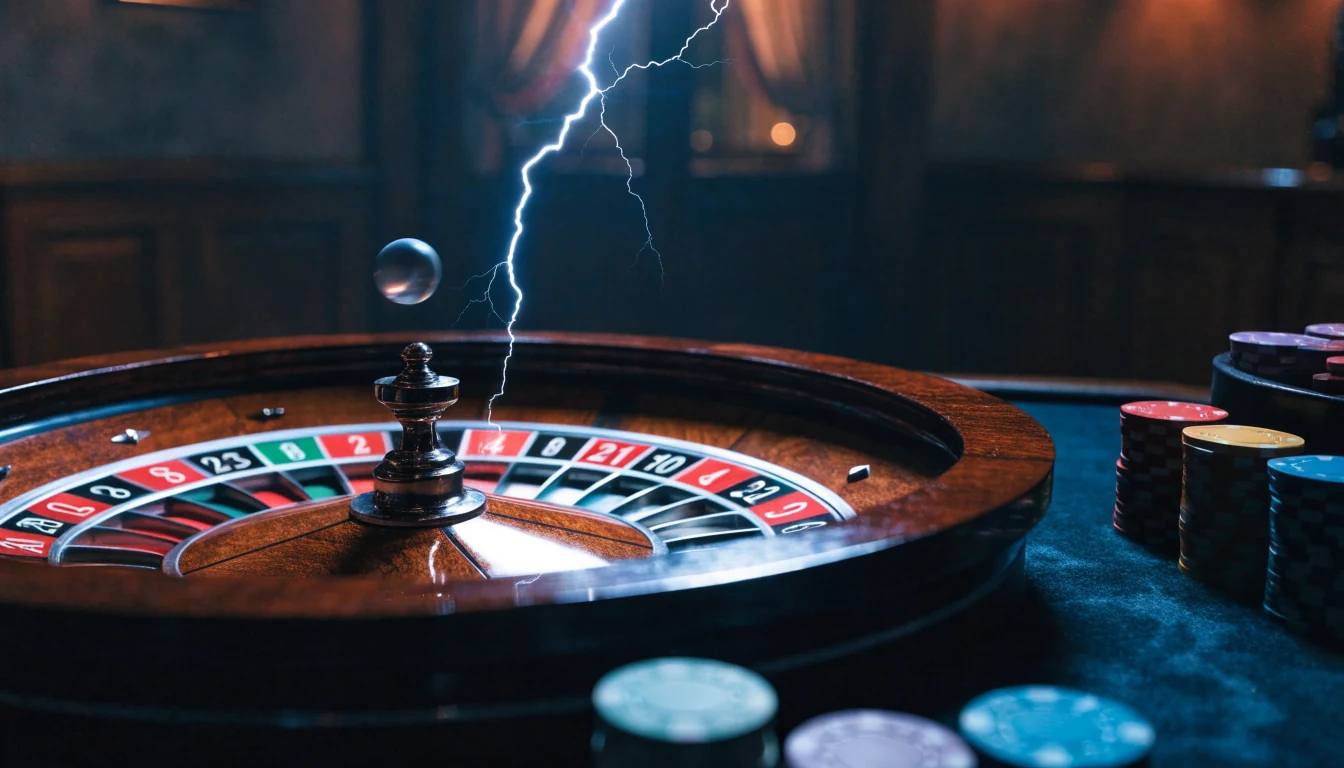
What the Roulette Numbers Tell You
Before the name Lightning Roulette starts doing any work, look at the wheel underneath it. Roulette comes in different layouts, and the number of pockets matters: it sets the basic odds before any special presentation or feature enters the picture. The familiar European and American versions look similar on the table, but their wheels are not the same.
European Roulette has 37 pockets: the numbers from 1 to 36, plus one zero. American Roulette adds a second zero, giving it 38 pockets in total. That extra pocket is not decoration. With the same number of numbered outcomes and another way for the house to win, the American layout has a higher house edge: 5.26%, compared with 2.70% on the European wheel.
That is the first useful distinction when you are trying to understand Lightning Roulette numbers. A numbered result belongs to the wheel’s pocket layout; the table is where bets are arranged. Those are related, but they are not interchangeable. In roulette terminology, called bets refer to groups based on where numbers sit around the wheel, rather than where they appear on the betting layout. It is a small detail that can make the game’s vocabulary less confusing.
French Roulette uses the same single-zero arrangement as European Roulette. Its difference is in the rules that can apply when the ball lands on zero, not in an extra pocket or a different set of numbered outcomes. La Partage and En Prison concern even-money outside bets, such as bets on a colour or whether the result is odd or even. They come into play only when zero appears; they do not apply to every kind of wager.
Under La Partage, half of an eligible even-money stake is returned after zero, while the other half is lost. En Prison handles that situation differently: the bet is held over for the following spin. If that next result favours the original bet, the stake comes back without a further win; if it does not, the stake is taken. These rules make the French layout worth recognising, but they do not change the pocket count. The wheel remains single-zero.

That distinction is a sensible starting point for reading Lightning Roulette rules. First identify the underlying roulette layout, then separate its ordinary wheel structure from any game-specific features. The word “Lightning” does not, by itself, tell you whether a table has one zero or two. Nor should a feature name be mistaken for a change to the basic set of roulette numbers. Check the rules displayed for the particular game rather than assuming every version uses the same setup.
People often look for a particular number to play or wonder whether betting on every number can cover the whole game. The wheel basics do not point to a special number: each pocket is part of the layout, and knowing how many pockets there are helps explain the odds, not identify a favoured result. Covering numbers is a question about bet choices and risk, not a way to alter the wheel.
So when you see Lightning Roulette, keep three things separate: the wheel’s pockets, the table’s betting areas and any added game features described in that version’s rules. European and French Roulette share the single-zero wheel; American Roulette has both zero and double zero. French rules can change what happens to eligible outside bets when zero lands, but they do not add another pocket. The numbers come first. The branding can wait.
Lightning Roulette Live: What Changes Online
The word “live” changes the setting, not the basic idea of roulette. In a live-casino version, the game is presented as a live table experience online; that is different from a standard digital roulette game, where the play is presented through software rather than as a live table. The distinction matters if you want the atmosphere of a hosted game, but it does not make the outcome more predictable.
I find it useful to separate three things that can get bundled together on a game page: the roulette variant, the live format and the website carrying it. “Lightning Roulette” names the game variant. “Live” describes how the experience is presented. The casino website is the place you access it. Those labels answer different questions, and one does not tell you everything about the others.
That is why I would not assume every live version looks or works in exactly the same way. A title alone does not tell you how the table is presented, what information appears on screen, or which rules apply. Read the game’s own information before joining, rather than filling gaps with assumptions based on another roulette table you have seen. Plain, but useful.
The contrast with general online roulette is mostly about presentation. A software-based game can provide a self-contained digital experience; a live table is framed as a real-time casino session. That may make the second feel more social or immediate. It does not change the underlying point that a roulette spin is an independent event. What happened on the previous spin does not alter the probability of what happens next.
This is easy to lose sight of when the screen is busy or the session feels like a continuous show. A sequence of results can look as though it is building toward something, but it is still a sequence of separate outcomes. Neither the live setting nor a dramatic run gives the next result a memory. I keep that distinction in mind: presentation can affect how a game feels, not the independence of its spins.

If you are comparing a live-casino version with an online roulette game, look first at what is actually identified on the page. Is it clearly the Lightning Roulette variant? Is it presented as live play, rather than a software-only game? Are the table’s rules and information available before you join? Those checks help you understand what you are looking at without assuming that every product carrying a similar name offers the same experience.
The phrase “online casino” can also be misleadingly broad. It may refer to a website’s collection of games, while “live casino” points to a particular format within that collection. Finding Lightning Roulette in a casino’s game list does not, by itself, establish that the version is live. Equally, seeing a live-casino label does not explain every detail of the table. Check the individual game entry.
One other trap is treating promotional wording or a dramatic game label as a promise about what will happen in a session. A title or number included in a description is not a prediction of a result, and it cannot make a past spin relevant to the next one. Keep the game’s presentation separate from its probabilities.
For me, the sensible way to approach live Lightning Roulette is to decide whether you prefer the live-table format, then confirm the version and rules shown on screen. Don’t confuse a more engaging presentation with better chances, and don’t read a run of results as a signal. The table may feel more immediate. The odds do not take hints.
First Person Lightning Roulette: Keep the Name in Perspective
“First Person” can make a roulette title sound as if the player is seeing a different kind of game. I would not read that much into the label. It does not, by itself, tell you what the interface looks like, how a round is presented, or whether the underlying odds differ from another version. Check the information shown for the particular game rather than filling in those details from its name.
The point that does not change is how roulette outcomes work: spins are independent. A run of red results does not make black more likely next time, and a number that has not appeared for a while is not due. The previous result has no effect on the probability of the next spin.
That is easy to understand and surprisingly easy to forget. A different viewpoint, animation or presentation can make a round feel more immediate, but it cannot make the last result useful for predicting the next one. I keep that distinction clear: presentation is what you see; probability is not altered by what you saw before.
People looking for a first-person version may also be trying to find a free trial or a place to play. The title alone cannot confirm that a demo is available, or that a particular site carries the game. Availability can vary, so check the game listing and its rules directly. A free version, if offered, can help you become familiar with what is on screen; it cannot show that a pattern will repeat or improve the odds of a later real-money spin.

The same caution applies when a page mentions an RTP figure. RTP is a label to assess against the information for the specific game, not something you can infer from “First Person” in the title. I would not treat a figure attached to a different roulette game as proof of this version’s return, or as a forecast of what you will receive in a short session. A percentage, even when clearly stated, does not promise a personal result.
You may also see this game described alongside payment methods or access terms. Those are separate questions from the roulette format. The words in a game title do not establish whether a site accepts a particular payment method, what its conditions are, or whether it is available to you. Read the site’s own current terms before making a decision; don’t assume one listing answers all of that.
If you are comparing versions, focus on details that are actually stated for each one, and keep the name in proportion. “First Person” is not evidence of better chances, a predictive view, or a way around roulette’s randomness. Nor does a memorable sequence on screen become a signal just because the presentation feels personal.
I would approach every spin as a fresh, uncertain outcome, whether the game is shown from a first-person perspective or another view. Set a limit you can afford to lose and stick to it. Every real-money bet can lose. The camera is not a crystal ball.
A Roulette Strategy That Starts With the Odds
When someone asks me for the best Lightning Roulette strategy, I start by asking what the table’s rules actually are. A game’s name does not tell you enough to assess a bet. Before choosing one, check the wheel layout and the rules attached to it, especially what happens when zero lands. That is a more useful starting point than looking for a pattern in recent results.
European Roulette
Contains 37 pockets (1-36 plus one zero) with a house edge of 2.70%.
American Roulette
Contains 38 pockets (1-36, zero, and double zero) with a higher house edge of 5.26%.
French Roulette
Uses a single-zero wheel and may apply rules like La Partage or En Prison to reduce the house edge on even-money bets.
The clearest rules-based advantage is on French Roulette tables that apply La Partage or En Prison. Both rules concern even-money outside bets, such as red or black, and apply when zero lands. With La Partage, half your stake is returned and the other half is collected. With En Prison, the bet is held for the next spin: if it wins, your original stake comes back without extra winnings; if it loses, the stake is collected.
These rules reduce the house edge on eligible even-money bets, which is why French Roulette offers better odds for that type of wager. La Partage can lower the effective house edge when zero lands. That qualification matters: the rule does not apply to every kind of bet, and the advantage should not be treated as a promise of profit. It changes how a particular outcome is handled, not the uncertainty of the game.
I would not assume that every roulette table labelled Lightning uses French rules. Read the table information and confirm which layout and zero rules apply. If the game does not offer La Partage or En Prison, do not count on their reduced edge. A roulette lightning strategy built on the wrong rules is just a confident guess.
It also helps to separate a lower house edge from a winning system. The first describes the terms of the game; the second would claim to control results. No staking pattern can remove the house edge, and changing your bet after a win or loss does not make a future spin more predictable. I keep my decision simpler: understand the bet, decide what I can afford to lose, and stop if that limit is reached. Dry, but useful.
If you are trying to beat Lightning Roulette, be wary of advice that promises a reliable route to doing so. Roulette outcomes are random, and previous results do not improve the odds of a later bet. A strategy can help you choose rules that are less costly for an eligible wager and keep your spending deliberate. It cannot turn the game into a dependable source of income.
For me, that is what a sensible strategy means: compare the rules, recognise where French protections apply, and choose whether the risk suits you. Do not stake more than you can afford to lose. If the table’s rules are unclear, pass rather than filling the gaps with assumptions.
How to Play—and Why No Bet Guarantees a Win
The basic choice at a roulette table is what you want your stake to cover. You can select a specific number or a broader group of numbers on the betting layout. A narrower selection is harder to hit; a broader one covers more possible results. Neither choice makes a win certain, and a bet that feels safer can still lose when the ball lands elsewhere.
Do
- Understand bet options before committing money
- Set a firm limit you can afford to lose
- Accept that each spin is an independent event
Don't
- Treat a run of results as a clue or signal
- Chase losses by raising your stakes
- Trust claims of guaranteed wins or patterns
For Lightning Roulette, the sensible first step is to understand the bet options shown in the game before committing money. The name does not change the central roulette decision: choose what to back, decide what you can afford to stake, and accept that the result may go against you. If the rules or labels are unclear, pause and read them rather than guessing. No need to rush.
I’ve seen people treat a run of results as if it were a clue. A number has appeared several times, so surely it is “due”; or it has not appeared, so surely it is next. Neither conclusion follows. Each spin is independent, and previous results do not alter the probability of what happens on a future spin. A long gap is not a promise. A streak is not a signal.
That matters when you are choosing how to bet. You may prefer a single number, or a wider selection, but your preference does not make the wheel favour that choice. Nor does changing stakes after a win or loss control the next result. Betting systems can organise decisions; they cannot remove the chance of losing or turn past spins into reliable information about the next one.
There is no dependable way to cheat Lightning Roulette or guarantee a win. Claims that a trick can reveal the next result, beat the game every time, or exploit a supposed pattern should be treated with caution. Trying to interfere with a game is not a sound alternative to placing a bet, either. The straightforward answer is less exciting: roulette is random, and every real-money bet can lose.
If you are deciding how to play, keep the decision small and clear. Know what you have selected, know what you are staking, and do not risk more than you can afford to lose. If you feel tempted to chase a loss by raising the stake, step away instead. A run of bad results can feel personal. It isn’t.
The same goes for an app. Downloading one may change how you access a game, but it does not give you control over roulette outcomes. An app cannot make an earlier spin influence a later one. The interface may make placing a bet feel quick; take the time to check your selection before confirming it.
So the best way to approach a bet is not to look for a guaranteed system. It is to make a choice you understand, set a firm limit for yourself, and be prepared for the result to be a loss. No clever sequence changes that.
Trying Roulette for Free Before You Play
Free online roulette can give you room to get used to making choices without staking your own money. That is its practical value: you can see how a roulette table presents its options and take time to understand what you are selecting before a real-money decision is involved. It is practice with the format, not a way to improve the chance of a particular result.
If you are looking for a free version of Lightning Roulette, availability depends on the site and its game options. I would look for a clearly labelled free-play choice beside the game, rather than assume that every listing offers one. Read the on-screen terms before starting, too. A free mode may have different conditions from real-money play, and its presence does not tell you whether a particular service is suitable for you.
The main thing to learn is how your selections are shown and what the table says they pay. Take a moment to check the wording and payout attached to a choice rather than relying on a quick glance. If a label is unclear, pause and work it out before placing anything. That small habit is more useful than rushing through several spins.
Free play can also help you notice how easily you start treating a run of results as a pattern. Roulette spins are independent: what happened earlier does not alter the probability of what comes next. A sequence that looks striking is still just a sequence of outcomes, not a signal that the next one is due. Free play is a safe setting in which to notice that temptation; it cannot make the temptation reliable.
Keep the limits of the exercise in view. Playing without a stake does not recreate the pressure of risking money, and a stretch of free results cannot forecast what will happen later. Nor does becoming comfortable with the controls change the game’s underlying odds. When you move from free play to real-money play, every bet can lose. Do not risk more than you can afford to lose.
If a site attaches a bonus to an offer, read its conditions separately from the free-play option. Bonus money must be wagered 50X within 30 days, while winnings from free spins must be wagered 50X within 7 days. A withdrawal request voids all active or pending bonuses. Those terms can matter even when the initial offer sounds straightforward, so check what applies before accepting anything.
Use free play for familiarity: learn where choices appear, read the payout information, and get comfortable taking your time. Then keep that knowledge in its proper place. It can help you understand what you are doing; it cannot tell you what the wheel will do next.
Bonuses, Tracking Claims and Predictions
A Lightning Roulette bonus can look generous until you read the conditions attached to it. I check who is eligible, when the offer expires, which games count towards its wagering requirement and what restrictions apply to withdrawals. A headline figure tells you little if roulette contributes differently from other games, or does not count at all.
The wagering conditions matter. Bonus money must be wagered 50X within 30 days; winnings from free spins must be wagered 50 times within 7 days. A withdrawal request voids all active or pending bonuses. Those terms can affect whether you can use an offer as you expected, so read them before opting in rather than after a balance changes.
If an offer mentions bitcoin, treat the currency as a payment detail, not a roulette feature. Whether an offer is described alongside Lightning Roulette or bitcoin does not tell you which bets or games qualify. Check the actual terms for eligibility, game contribution, expiry and withdrawal restrictions. If a condition is unclear, do not assume the most favourable interpretation.
Tracking claims need the same careful reading. A record of recent numbers can describe what has already happened; it cannot make a number more likely on the next spin. Roulette spins are independent, so previous results do not change the probability of future outcomes. A streak may look meaningful on a screen, but it does not create a reliable signal.
The same applies to a prediction tool or a promised predictor. A chart, algorithm or suggested number may organise past results or offer a guess, but none can know the next random outcome. I would not treat a prediction as an edge, and I would not pay for a claim that it can reliably identify what comes next. Neat interface. Same uncertainty.
Keep bonus decisions separate from predictions. An offer’s terms describe how the promotion works; they say nothing about which roulette result will land. And tracking describes past outcomes, not a route through wagering conditions. If you choose to play, do not risk more than you can afford to lose.
Roulette Results and Statistics: Read the Percentages
Roulette figures are useful for comparing stated returns, but they are not a forecast of what will happen at the table. A payout percentage describes a calculated return across play, not a promise about an individual session or spin. A result can differ sharply from the percentage shown.
A specialist review reports a payout percentage of 94.70% for American roulette and 97.30% for European roulette. Those figures put the two versions side by side: the stated return for European roulette is higher. They should still be read as attributed figures, rather than as a guarantee that a player will receive that share of their own stakes. Actual results vary.
For 100/1 roulette, a specialist review gives a payout-percentage range of 92.86% to 96.19%. A range is a reminder to check which version or table a statistic describes. A label alone does not tell you that every game carrying it has the same stated return.
That distinction matters when you look up Lightning Roulette results or statistics. A list of past results records what has already landed; it does not establish the probability of the next result. Roulette spins are independent, so a run of repeated outcomes does not make a different number due. The figures above are for named roulette formats, and should not be transferred to Lightning Roulette as if every variant had an identical payout percentage.
You may also see Lightning Roulette described alongside casino slots, but the label does not make its results slot statistics. Read the game and the figure being reported carefully: a payout percentage is meaningful only in the context of the specific version it refers to. A table of recent outcomes and a stated return answer different questions.
I find it helpful to treat percentages as comparison tools, not predictions. The American and European figures offer a direct contrast, while the 100/1 range signals variation in the reported figure. None tells you whether a particular bet will win. Every real-money roulette bet can lose, and past results do not change the odds of a future spin.
What a Lightning Roulette Demo Can Actually Show You
A Lightning Roulette demo can be useful for getting your bearings before you decide whether the game feels clear to you. If a site offers a free version, you can look at how its screen presents the wheel, the betting area and the result of a spin. That familiarity may make the layout easier to follow later. It does not make the game more predictable.
A demo is not a forecast. The results you see during free play do not tell you what will happen on a later spin, whether you stay in demo mode or move to real-money play. Roulette spins are independent: previous results do not alter the probability of outcomes on future spins. A run of one colour, or a result that seems overdue, has no bearing on the next outcome.
That distinction is easy to lose when you are watching a sequence unfold. Free play can feel like practice because you can become familiar with the interface and observe how a round is displayed. But it cannot show that a certain pattern is about to repeat, or that a past sequence has changed what comes next. A demo gives you context, not an edge.
It is also worth keeping the word “free” in perspective. A demo does not involve risking your own money, but any real-money bet can lose. If you later choose to play for money, do not risk more than you can afford to lose. Familiarity with the screen is no guarantee of a particular result.
Some sites may not provide a demo, so do not assume that free access is available everywhere. Where it is offered, use it to see whether you can follow the presentation without pressure. If the layout is confusing, that is useful to learn before making any decision. Just leave the prediction theories out of it. They add nothing.
Playing Online in New Zealand in 2026
Choosing a lightning roulette site in New Zealand means checking which options have clearly stated details that matter to you. Use these verdicts as a concise reference when deciding where to play.
-
Lamabet
- Payout speed
- 1-3 business days
Lamabet lists a payout speed of 1–3 business days, giving you a stated timeframe to consider.
-
Ricky Casino
- License
- Tobique Gaming Commission, licence no. 0000002
Ricky Casino lists a Tobique Gaming Commission licence, number 0000002. This gives you a specific licensing detail to check.
-
7Bit Casino
- License
- Tobique Gaming Commission, licence no. 0000091
7Bit Casino lists a Tobique Gaming Commission licence, number 0000091. You can use that information when reviewing its credentials.
-
BitStarz
- License
- Curaçao Gaming Authority, licence no. OGL/2024/165/0185
BitStarz lists a Curaçao Gaming Authority licence, number OGL/2024/165/0185. This provides a specific licensing detail for your review.
-
Zotabet
- License
- 07017519840
- Payout speed
- 1-3 business days
Zotabet lists licence number 07017519840 and a payout speed of 1–3 business days. These stated details give you concrete points to consider.
-
Neospin
- License
- Tobique Gaming Commission, licence no. 0000064
Neospin lists a Tobique Gaming Commission licence, number 0000064. You can take this stated licence information into account.
-
Play Grand
- License
- Malta Gaming Authority, licence no. MGA/B2C/370/2017
Play Grand lists a Malta Gaming Authority licence, number MGA/B2C/370/2017. This gives you a specific credential to verify.
-
Wintino
- Payout speed
- 1-3 business days
Wintino lists a payout speed of 1–3 business days, so you have a stated timeframe to consider.
-
N1 Casino
- License
- Malta Gaming Authority, licence no. MGA/B2C/394/2017
N1 Casino lists a Malta Gaming Authority licence, number MGA/B2C/394/2017. You can use this detail when reviewing the operator.
New Zealand’s online casino rules changed on 1 May 2026, when the Online Casino Gambling Act 2026 came into force. It creates the country’s first domestic licensing system for online casino gambling. Until then, online casinos based overseas were not licensed or supervised by a New Zealand regulator, leaving customers without domestic government recourse if a dispute arose.
The Department of Internal Affairs is the primary gambling regulator and oversees the online casino licensing framework. The Gambling Commission handles licence applications and decides whether to grant them; it also approves changes to licence conditions. The roles are distinct: the Department oversees the framework, while the Commission makes licensing decisions.
There is a transition period from 1 May to 1 December 2026. Providers that were already serving New Zealand customers before the Act began may keep operating during that period under its transitional provisions. The full licensed regime is not expected to be running until 2027. Domestic online casinos remain prohibited under the Gambling Act 2003, so the new system is not permission to set up a casino based in New Zealand.
The transition is not a general invitation to promote online gambling locally. Advertising online casino gambling to people in New Zealand is prohibited during this period. Providers that were not already operating before the Act took effect cannot rely on the transitional allowance. From 1 December 2026, existing providers that have not applied for a licence must stop serving New Zealand customers. Unlicensed operation is expected to become an offence around the middle of 2027.
If you are looking at Lightning Roulette online, keep that distinction in mind: access during the transition does not mean a provider holds a New Zealand licence. The framework is still taking shape. Check the legal status, not just the game title.
Casino Games in New Zealand: Slots and Table Games
Content created by the «casinotips-nz.com» team