
Understand What Each Craps Bet Is Backing
 Available in US
Craps wagers can settle on one roll or remain active across several, depending on the outcome or condition they cover.

What a Craps Bet Is Actually About
Craps is a dice game in which you wager on what will happen when two dice are rolled. A bet can concern the result of a single roll, or it can stay in play across a sequence of rolls. That is the central idea: you are not simply choosing a number and hoping to see it. You are backing an outcome whose meaning depends on whether the wager is about one roll or a longer stretch of play.
That distinction is worth getting straight before looking at the betting options. A single-roll bet has a short life: the roll it refers to decides the result. A bet tied to a sequence asks you to follow what happens over more than one roll. The dice are the same, but the question your wager answers is different. It might be settled straight away, or it might remain unresolved while the game continues.
I find this is where craps can look busier than it really is. There may be many wagers available, but each one still comes down to a prediction about the dice. You are not making a general bet that the game will go well for you; you are choosing a particular outcome or a condition that has to be met. Once you keep that in mind, the range of betting choices becomes easier to approach.

Think of the game as a series of decisions with different time frames. One wager may be concerned only with the next result. Another may depend on what happens over several rolls. These are not interchangeable ways of placing the same bet: the period you are betting across changes what counts as a win or a loss. It also changes how long you may need to keep track of the wager.
For a newcomer, the practical question is simple: what exactly am I predicting, and when will this bet be decided? If the answer is “the next roll,” you can expect the wager to be resolved on that roll. If it refers to a sequence, the result may depend on how the rolls unfold, not just on the first one. That basic distinction gives you a useful way to read the game without trying to memorise every betting option at once.

Craps gambling, then, is not one single prediction repeated in different forms. It is a game built around wagers on the outcome of one roll or a series of rolls of two dice. The specific bet tells you which outcome matters and how long the wager remains relevant. You do not need to know every option before grasping that structure; you only need to separate a bet on one result from a bet that follows the game onward.
Keep that distinction in view as you learn the rest. It stops the betting choices from blurring together and gives each one a clear starting point: what is being predicted, and whether the wager ends with one roll or continues beyond it. Simple enough.
The Dice and the Moment Bets Close
Craps uses two dice, and the timing of a wager is tied to the shooter’s next roll. You need to have your bet in place before the dice are thrown. Once they leave the shooter’s hand, that decision is made; the roll is not a chance to add a wager halfway through.
That sounds simple, but it is the detail newcomers can miss when watching a busy table. Attention tends to follow the dice, while the betting window comes before them. I find it easier to think of each turn as a short sequence: decide whether to bet, place the wager, then let the shooter roll. Keep those steps in order and you are less likely to be unsure whether a bet belongs to the roll that is about to happen or one that has already happened.
The two dice are the equipment at the centre of the game, but for this part, their result is beside the point. What matters is that the shooter rolls them only after players have had the opportunity to make their bets. The same timing applies whether you are following the action closely or waiting to see what happens before deciding what to do next: a decision made after the dice are thrown cannot be treated as a wager on that roll.
Do
- Settle your choice before the shooter is ready
- Watch the sequence of the turn
- Wait for a later roll if you are unsure
Don't
- Add a wager halfway through the roll
- Chase a moment that has already passed
- Try to act at the last second
A useful habit is to settle your choice before the shooter is ready. If you are still deciding as the roll begins, leave the wager alone and take time to understand the table’s pace. There is no need to chase a moment that has passed. Craps moves through repeated turns, so another opportunity to consider a bet will come with a later roll.
At a casino table, the shooter handles the dice, while you are responsible for making your own wager in time. Watch the sequence rather than trying to act at the last second. Once you know when betting has to happen, the dice are easier to follow and the table feels less rushed.
Bet first. Then watch.
The Come-Out Roll: Natural, Craps, or a Point
The first roll of a new craps round is called the come-out roll. It sorts the opening result into one of three categories: a natural, craps, or a point. If you know those labels, the Pass Line and Don’t Pass rules are easier to follow without trying to read every mark on the table at once.
A natural is a total of 7 or 11. A total of 2, 3, or 12 is called craps. Any of the other possible totals—4, 5, 6, 8, 9, or 10—establishes a point. The names are easy to mix up at first: “craps” is one specific result, not a label for every roll in the game.

How the opening bets respond
On the Pass Line, a natural wins straight away. A come-out total of 2, 3, or 12 loses. If the roll establishes a point, neither of those opening outcomes has happened, so the bet remains in play; what follows belongs to the next phase.
Don’t Pass reverses the natural and craps results. A 2 or 3 wins for the Don’t Pass bet, while 7 or 11 loses. A 12 is different: the bet pushes, meaning it is neither a win nor a loss on that roll. That small exception is worth remembering; it prevents a common mistake when comparing the two starting bets.
There is one detail that can sound contradictory. A total of 2, 3, or 12 is grouped under the name craps, but the Don’t Pass result is not identical for all three: 2 and 3 win, while 12 pushes. On the Pass Line, all three lose. A natural also treats the two bets differently: Pass Line wins, Don’t Pass loses.
If the come-out total is a point number, the game continues rather than settling either bet immediately. For the opening roll, keep the outcomes in pairs: 7 or 11 favours Pass Line; 2 or 3 favours Don’t Pass, with 12 as its push. The point numbers simply move the round forward. That is the opening map.
Natural
A total of 7 or 11 on the come-out roll.
Craps
A total of 2, 3, or 12 on the come-out roll.
Point
Any total other than the above (4, 5, 6, 8, 9, or 10).
After the Point: Come Bets and Their Odds
Once the come-out roll establishes a point, the round moves into its next phase. The Pass Line and Don’t Pass bets remain in play, but they are now waiting on different results. A Pass Line bet wins if the shooter repeats the point before rolling a 7. A Don’t Pass bet takes the opposite route: it wins if a 7 appears first. If neither deciding result arrives, the round continues.
That makes the point a marker for the rest of the sequence, not an immediate result. You can follow the two bets by keeping track of which event each needs: the Pass Line needs the point, while Don’t Pass needs a 7. The first of those outcomes to appear settles the bet.
A Come bet gives you a separate way into the action after a point has been set. It starts with the next roll, rather than attaching directly to the established point. If that roll is 7 or 11, the Come bet wins; if it is 2, 3 or 12, it loses. Those results settle the Come bet at once.
A different outcome changes the bet’s status. If the next roll is 4, 5, 6, 8, 9 or 10, that number becomes the Come bet’s number. From then on, it wins if the shooter rolls that number again before a 7. A 7 arriving first loses the bet. In practice, you now have two number-based wagers to track: the original point bet and the Come bet that has travelled to its own number.

That movement is the useful distinction. A Come bet is not simply another wager on the table’s original point. It begins after that point exists, then may acquire a different number according to the next roll. If it does, it follows the same basic race between its number and a 7.
Once a Come bet has moved to a box number, you can place an Odds wager behind it. That additional wager is tied to the moved Come bet, rather than being a fresh Come bet or a change to the original Pass Line wager. The order matters: first the Come bet is made; then a qualifying roll moves it to a number; only after that can Odds be added behind it.
Keep the sequence straight and the table is easier to read: the point is established, the line bets wait on their respective outcomes, and a later Come bet either settles immediately or moves to a number. Odds come after that move. Small steps, separate bets.
How Craps Plays as a Casino Game
Craps sits in the table-game corner of a casino, alongside games where play is organised around a shared layout and a set of rules. The label tells you the kind of game, not whether you are looking at a physical table or a screen. That distinction matters when you are trying to understand what “craps” means in a casino listing: the same game can be presented in different formats.
A table game is the broad category. In a physical casino, players gather around a craps table and take part in the same round. Online, the table-game label can describe a software version, where the game is presented digitally rather than through a live dealer. The interface may look like a table, but the format is not the same as a live casino broadcast. Think of “table game” as the game family, not a promise about who or what is running the action.
A live casino game is a different kind of presentation. A dealer appears on a live feed and conducts the game, while players follow from their own screens. The physical table remains part of the scene, but you are not standing around it. A specialist review of casino options for New Zealand has reported craps in both table-game and live-casino formats on a number of sites. Availability can change, so that description is a report about offerings, not a guarantee that every site has both.
That is the useful distinction: table game describes the category; live casino describes how the game is delivered. A live craps game is still craps, not a new ruleset. If you are comparing formats, look for whether the listing says software-based or live, then check what the page actually shows. A live label points to a dealer-led presentation; a table-game label on its own does not tell you that a dealer is involved.

For a newcomer, the labels can be more confusing than the game. A screen may show a table layout in either format, so the visual alone is not always enough. Check the game description before you assume there is a live dealer, or that a live feed is part of the experience. The distinction is practical, not technical fuss.
There is also a New Zealand boundary worth keeping clear. Remote interactive gambling is prohibited in New Zealand, and domestic online casinos are not permitted. The Online Casino Gambling Act 2026 has introduced a transition towards a domestic licensing system, but that does not make every remote casino offering locally licensed or supervised. An unlicensed platform does not provide the same player protections as a locally regulated service. Before the new framework, offshore online casino play had no domestic government recourse for customers. Plainly put, a casino-game label is not a licence.
So when you see craps described as a casino game, read it as a format clue only after checking the details: the game may be software-based or presented with a live dealer, but those are different experiences within the same broad category. The table is the setting; the format tells you how the game reaches you.
Reading the Craps Table: Place Bets and Box Numbers
Once you know what the table’s number areas are for, the layout becomes easier to read. A place bet is a wager on one of six box numbers: 4, 5, 6, 8, 9 or 10. The bet wins if its chosen number comes up before a 7. That is the whole idea. You are not betting on every possible dice total, but on a particular number beating the 7 to the next relevant result.
Eligible box numbers
Place bets are made on the six numbers split around 7: 4, 5, and 6 on one side, and 8, 9, and 10 on the other.
The term “box number” can sound like a special rule. It is simply a way to refer to the numbers covered by these bets. When you look across a craps table, focus on the printed numbers rather than trying to memorise every marked area at once. The six eligible numbers are split around 7: 4, 5 and 6 on one side, 8, 9 and 10 on the other. The 7 is the comparison point for a place bet, not one of the numbers you choose for it.
That distinction is useful when you are new to craps table gambling. A box number is not automatically a bet; it is the result you select when making a place wager. If you choose 6, for instance, you are backing 6 to appear before 7. Choose 9, and the same basic comparison applies to that number instead. I find it clearer to read the bet as “my number before 7” than to treat the table markings as a set of unrelated instructions.
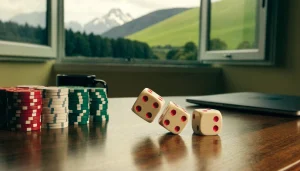
Place bets give you a direct way to focus on one of the listed numbers. You can understand their purpose without learning every other wager on the table. For now, keep the central condition in view: the selected number must be rolled before 7. A place bet on 4 is about 4 against 7; one on 10 is about 10 against 7. The other eligible numbers follow that same pattern.
The 7 matters because it is the number each place bet must beat. If you are scanning the layout, do not confuse the six selectable box numbers with the result that ends their race. That small distinction makes the marked betting areas less intimidating. You can look at a number, identify it as one of the six, and understand what the wager is asking without needing a full diagram of the table.
It also helps to separate the label from the action. The printed number tells you which result your place bet is tied to; the rule tells you that it must arrive before 7. So, when someone refers to a place bet on a box number, they mean a wager on one of 4, 5, 6, 8, 9 or 10 under that condition. No extra table vocabulary is needed to grasp the basic choice. Keep the number and the 7 in mind. That is the useful part.
Online Craps in New Zealand: The 2026 Market Shift
If you’re looking into craps gambling in New Zealand in 2026, this list gives you a concise reference point for considering operators. Check the details relevant to you before choosing where to play.
-
Lamabet
- Payout speed
- 1-3 business days
Lamabet lists a payout speed of 1–3 business days. That’s the specific detail available here for your consideration.
-
Ricky Casino
- License
- Tobique Gaming Commission, licence no. 0000002
Ricky Casino lists a Tobique Gaming Commission licence, no. 0000002. This is the licensing detail provided for your reference.
-
7Bit Casino
- License
- Tobique Gaming Commission, licence no. 0000091
7Bit Casino lists a Tobique Gaming Commission licence, no. 0000091. The licence information is the specific detail available here.
-
BitStarz
- License
- Curaçao Gaming Authority, licence no. OGL/2024/165/0185
BitStarz lists a Curaçao Gaming Authority licence, no. OGL/2024/165/0185. This gives you a specific licensing detail to consider.
-
Zotabet
- License
- 07017519840
- Payout speed
- 1-3 business days
Zotabet lists licence number 07017519840 and a payout speed of 1–3 business days. These are the details available here for your consideration.
-
Neospin
- License
- Tobique Gaming Commission, licence no. 0000064
Neospin lists a Tobique Gaming Commission licence, no. 0000064. This is the specific information provided about the operator.
-
Play Grand
- License
- Malta Gaming Authority, licence no. MGA/B2C/370/2017
Play Grand lists a Malta Gaming Authority licence, no. MGA/B2C/370/2017. You can use that licensing detail as one point of reference.
-
Wintino
- Payout speed
- 1-3 business days
Wintino lists a payout speed of 1–3 business days. No other operator details are provided here.
-
N1 Casino
- License
- Malta Gaming Authority, licence no. MGA/B2C/394/2017
N1 Casino lists a Malta Gaming Authority licence, no. MGA/B2C/394/2017. This is the specific detail available here for your reference.
If you are looking at craps gambling in New Zealand in 2026, the important change is not in the game itself. It is in who may provide online casino gambling to people here, and when. The rules are moving from a system with no domestic licensing for offshore online casinos to a new licensing regime being introduced in stages.
The Gambling Act 2003 remains the primary law governing gambling activities in New Zealand. It does not permit online casinos to be based here, and remote interactive gambling provided from within New Zealand is prohibited. That is different from a New Zealander accessing an offshore casino: residents may play at offshore sites, but they cannot provide iGaming products in New Zealand. The distinction matters. A site being accessible to a player does not mean it is licensed or supervised by a New Zealand regulator.
Before the new law took effect, offshore online casino gambling was not licensed or supervised by a New Zealand regulator. A customer who wagered with an offshore website during that period had no domestic government recourse. An unlicensed platform also does not give you the same player protections as a provider operating under the new domestic system. Access and protection are not the same thing.
The transition dates to know
The Online Casino Gambling Act 2026 came into force on 1 May 2026 and created a transitional period. Online casinos that were already serving people in New Zealand before that date may continue operating during the transition, but only until 1 December 2026. This allowance is temporary; it is not a general approval for every offshore site.
After the transition ends on 1 December 2026, only operators that succeed in the auction process and are eligible to apply for an online casino licence may provide online casino gambling to customers in New Zealand. Providers that do not qualify through that process must leave the market. If an application is declined, the provider must cease its New Zealand online casino operations and exit. The rules also require providers without a licence to stop conducting online casino gambling here by the transition deadline if they have not applied.
The change is substantial. The 2026 Act establishes New Zealand’s first domestic licensing regime for online casino gaming. The Department of Internal Affairs (DIA) is leading its implementation. The new system is being phased in, though, rather than switching on in full at once: it is not expected to be fully operational until 2027, and the regulator expects to begin issuing licences from early 2027. So the transition deadline and the arrival of the fully operational regime are separate milestones.

That timing can make the status of a provider less obvious than a simple “licensed” label suggests. During the transition, an operator may be permitted to continue under transitional provisions without the new licensing regime yet being fully operational. Later, eligibility will depend on the auction and licensing process. The key is to distinguish temporary permission to continue from a licence under the completed system.
What this means for a player
For someone considering craps gambling online, the law’s main effect is on the provider, not the dice or betting rules. The transition does not make every site available to New Zealanders a locally licensed casino. Nor does it mean that the player is committing an offence merely by accessing an offshore casino: New Zealanders may play offshore, while providers may not supply iGaming products from within New Zealand. Those are different legal questions.
Still, the protections attached to a provider matter. Before the new regime, offshore sites were outside New Zealand regulatory supervision, and customers had no domestic government recourse. During the transition, do not mistake the right of an established operator to continue temporarily for full licensing under the incoming framework. Once the licensing system is operating, a provider’s ability to serve New Zealand customers will depend on the rules and approvals that apply then.
This is also why broad claims about “legal online craps” can mislead. The relevant question is not just whether you can open a page or place a wager, but whether the provider is permitted to serve customers here at that point in the transition. Providers that fail to qualify cannot keep operating in the New Zealand market after the applicable deadline. An operator whose licence application is declined must leave.
I would keep the calendar in view and treat the transition as a real change, not a technical footnote. In 2026, the legal position shifts between temporary continuation for qualifying existing providers and a system based on auction eligibility and licensing. The new regime is being built by the DIA, with licensing expected to begin in early 2027 and the system not expected to be fully operational until later that year.
For a Kiwi player, the practical takeaway is straightforward: offshore access does not equal local approval, and transitional permission does not equal a completed licence. The market is changing, and provider status depends on where the process stands. That is the part worth checking. Not the felt.
Playing Craps Online: Mobile, Live Dealers, and Free Practice
If you are looking at craps on a phone or computer, separate the way the game is presented from the rules of the bets. The format changes how you see and interact with a round; it does not turn the dice game into a different one. For a newcomer, that distinction is useful. You can decide whether a screen-based version or a live-dealer presentation suits you without first trying to compare every betting area on a table.

A specialist review reports that online craps in New Zealand can be played on mobile devices. That describes a format, not a guarantee that every game or provider will work on every phone. On a small screen, the practical question is whether you can read the table and identify your selected wager before play moves on. If the layout feels cramped or the controls are unclear, take a moment to inspect the screen rather than tapping through a round. At a craps table, a misplaced bet is no small interface detail.
The same review type reports that craps may be offered with a live dealer. In that format, a real dealer runs the game on camera while you follow the table through a screen. It can make the activity feel closer to watching a casino table than using an automated presentation, but the basic task remains the same: understand what is happening and make your own decisions. A live camera does not explain a wager for you. If you are still learning, focus on whether the table information is visible and understandable, not on the fact that a person appears on screen.
Automated and live-dealer versions are different presentations, not different promises about the result. In an automated game, the action is displayed through software; in a live game, you watch a dealer and table through a streamed view. The available specialist coverage describes both as possible ways to encounter online craps, but availability can change. So treat them as formats to check, not as a permanent catalogue of what a particular service must carry.
- Verify if the game is software-based or live-dealer
- Ensure the table layout is readable on your device
- Confirm if you are using a free demo or wagering NZD
- Check the provider's licensing status under the 2026 Act
Free practice is another way to approach the game without putting a New Zealand dollar on a wager. A specialist review reports that players in New Zealand can practise craps through free demo versions that require no NZD wager. That can give you room to learn how the interface presents the table and how a round progresses, while keeping practice separate from paid play. A demo is not a source of winnings, and it does not make later results predictable. It is simply a way to become familiar with the presentation.
When you open a demo, use it to learn the controls rather than to chase a pattern. Check how the game shows the current stage of a round, where your selected bet appears, and how the interface signals that a decision has been accepted. Those details matter on a phone as much as on a larger screen. If you cannot tell what you have selected, pause and work it out before continuing. No need to rush.
It also helps to decide what you want from practice. If your aim is to recognise the table, move slowly through the available screens and read the labels. If you want to observe the rhythm of a round, watch how the display changes as play proceeds. Keep the exercise simple: the point is familiarity, not proving that a sequence or betting approach will work. A free demo removes the wager; it does not remove the need to understand what the game is showing.

There is an important New Zealand distinction behind any discussion of real-money online play. Remote interactive gambling is prohibited from being provided in New Zealand, and an offshore service without a New Zealand licence does not give you the same player protections as a locally regulated provider. The legal position for providers is changing under the Online Casino Gambling Act 2026, but that does not make this a recommendation to use a site or place a wager. Keep practice and paid play separate in your thinking.
If you are comparing a mobile presentation, a live dealer, or a demo, the sensible questions are modest: can you read the information, do you understand the controls, and are you clear about whether you are practising or wagering? Specialist reviews can report that these formats are available, but a review is not a guarantee of current availability or a substitute for understanding the legal and player-protection position. Choose clarity over spectacle.
A Practical Craps Strategy: Know What Odds Bets Do
An Odds bet is an extra wager attached to a Pass bet after a point has been set. It does not replace the original bet or change what that bet is trying to do. It adds money to the same basic outcome: the point must appear again before a 7.
That distinction matters when you think about craps gambling strategy. Odds bets have no house edge, but that does not make the whole position risk-free or turn the Pass bet into a no-edge wager. The extra stake is judged separately; the original Pass bet remains in place, with its own outcome and risk. A zero house edge on one part is not a magic eraser. Small distinction, real one.
There is also a limit on how much you can put behind the Pass bet. The permitted Odds amount is capped relative to that bet, and the cap can depend on the table’s rules. So you cannot assume that any amount you choose will be accepted. Check the table information before adding the wager; the felt may make the space look simple, but the limit still applies.
The practical use is narrow. If you already have a Pass bet and want to add a wager that wins when the point beats a 7, Odds are the part to understand. They do not make a point more likely to arrive, control the dice, or protect you from losing the underlying bet. They only change how much you have at stake on that outcome.
I would treat the Odds area as a separate decision, not an automatic step in a system. Ask yourself whether you are comfortable risking the additional stake, and whether you understand the table’s cap. If not, leave it alone. You can play the Pass bet without adding Odds; there is no rule that says you must take them.
The useful takeaway is plain: no house edge on the Odds wager, a cap tied to the Pass bet, and no promise of a better result on any particular roll. Keep those points separate and the bet is easier to judge.
Craps Betting Systems and the House Edge
A betting system can change how you organise your wagers, but it cannot make a bet pay more often by itself. The useful starting point is the house edge: a measure of the built-in disadvantage attached to a wager over time, not a forecast of what will happen in a particular session.

A specialist review puts the Come bet’s house edge at about 1.4% when no Odds are added. Treat that as a sourced estimate, not a promise of a fixed loss or a prediction for your next run. Short stretches can go either way; the edge describes the wager’s long-run structure. It is a way to compare claims about systems with the bet they actually use.
That distinction matters when a system tells you to increase, decrease, or repeat your stake after a result. The pattern may alter the size and timing of your wagers, but it does not remove the Come bet’s stated edge. A winning sequence is not proof that the system has changed the underlying odds, any more than a losing sequence proves the next result is due to reverse. Dice have no memory. A tidy spreadsheet does not improve them.
I would judge any craps betting system by asking what it changes and what it leaves untouched. Does it simply prescribe a staking pattern, or does it make a claim about the chance of winning? If it claims to overcome the house edge, ask for evidence that can be checked against the specific bet and its rules. A confident name or a run of anecdotes is not enough to establish that.
This is not a reason to treat every session as a calculation exercise. It is a reason to keep the claim modest: a system can provide structure, but the Come bet’s edge remains a relevant benchmark. Do not confuse a plan for managing wagers with a method for changing the game’s mathematical advantage.
There is also a New Zealand context beyond the table. Remote interactive gambling is prohibited in New Zealand, and using an unlicensed platform does not give you the same player protections as a licensed service. A betting system cannot address that risk. Walk away if the stakes or the session stop feeling manageable.
Casino Games in New Zealand: Slots and Table Games
Content created by the «casinotips-nz.com» team